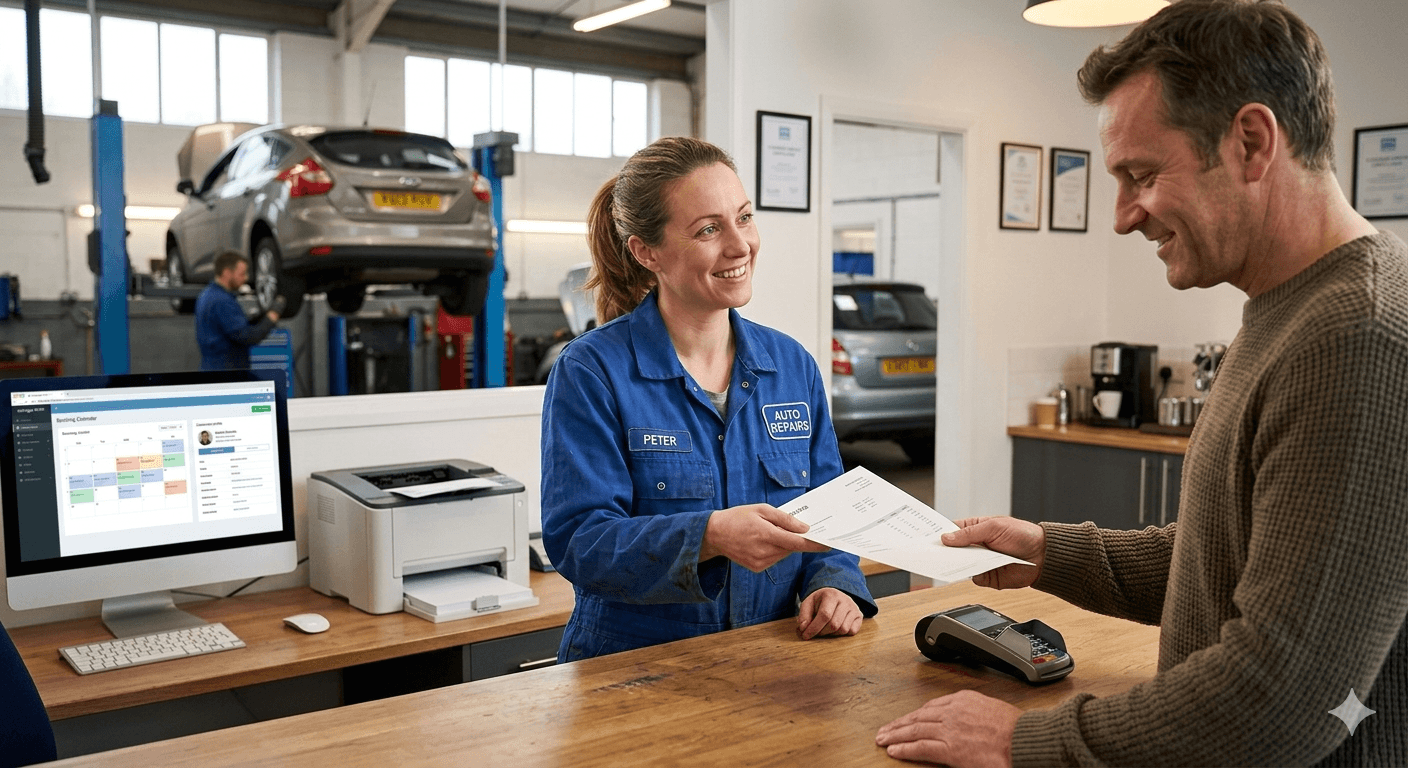
A garage invoice has to satisfy three readers: HMRC, the customer at the counter, and you, six months later, when that customer comes back about a noise. Here is what each of them needs to see, line by line.
Most garages start with an invoice template from the internet, a word processor, or a carbon-copy pad from the motor factor. That works until an accountant asks why the VAT does not add up, or a customer disputes a brake job and the invoice says "brakes, £240". The rules are not complicated, but they are spread across HMRC guidance, company law and plain common sense, so here they are in one place.
The basics every invoice needs
Whether or not you are VAT-registered, every invoice you send should carry the following.
- A unique invoice number that follows on from the last one. Gaps and duplicates are the first thing an HMRC inspector or an accountant notices.
- Your business name and address, and the customer's name and address.
- The invoice date, and the date the work was done if it differs.
- A clear description of the work, with each charge on its own line.
- The amount due, when it is due, and how to pay it.
Sole traders who trade under a name other than their own, "Smith's Autos" rather than "John Smith", must also show the owner's name and an address for documents on invoices and receipts. Limited companies must show the full registered company name on every invoice, and most also print the company number, the place of registration (England and Wales, Scotland, or Northern Ireland) and the registered office address, since those are required on business letters and order forms anyway.
If you are VAT-registered
Once your turnover passes the VAT registration threshold, currently £90,000 a year, your invoices become VAT invoices and HMRC sets out exactly what they must show. A full VAT invoice needs everything above plus:
- Your VAT registration number.
- The time of supply (the tax point), if it is different from the invoice date.
- For each line: the quantity, the unit price excluding VAT, the VAT rate, and the line total excluding VAT.
- The total excluding VAT, the total VAT, and any discount applied.
For retail sales of £250 or less including VAT you can issue a simplified invoice instead, which needs only your name, address and VAT number, the tax point, a description, the VAT rate and the total including VAT. In practice most garage jobs go over £250, so it is simpler to issue a full VAT invoice every time.
If you are not VAT-registered, do not show VAT on the invoice at all. Charging VAT without a registration number is not allowed, and a line reading "VAT: £0.00" just invites the question.
The MOT test fee is outside the scope of VAT. Put it on its own line with no VAT added, even when the rest of the invoice is standard-rated. Adding 20% to the MOT fee is one of the most common errors on garage invoices.
The garage-specific details
None of the following is a legal requirement. All of it is what you will wish you had written down the next time a customer comes back saying the car was fine before you touched it.
- Registration, make and model. An invoice without the reg is very hard to match to the car later, especially for a customer with two vehicles.
- Mileage at the time of the work. It dates the service history, backs up any warranty claim, and settles "you only changed that last month".
- Parts and labour on separate lines. Show each part with its quantity and price, and labour as hours times your rate. Customers query a single lump sum far more often than the same total broken down.
- Whether parts are new, reconditioned or used, where it matters. A customer is entitled to know what went on the car.
- Advisories you found but did not fix: worn tyres, a weeping shock absorber, a brake pipe that will fail its next MOT. Writing them on the invoice is your record that you told them, and it is next month's work.
- Your warranty on parts and labour, even in one line.
Payment terms that get you paid
For private customers, "payment due on collection" is the norm and it is worth printing anyway. For trade accounts, such as fleets, dealers and local businesses, state the terms plainly: "Payment due within 30 days of the invoice date", with your bank details on the invoice itself rather than in a separate email. On business-to-business invoices, the Late Payment of Commercial Debts Act lets you charge statutory interest on overdue amounts, and saying so on the invoice tends to be enough by itself.
Send the invoice the day the job is done. An invoice sent from the driveway or at the counter gets paid that week. One written up on Sunday night from notes on the back of a jobsheet gets paid when the customer remembers.
Keep your copies
HMRC expects you to keep business records for at least five years after the 31 January Self Assessment deadline if you are a sole trader, six years for a limited company, and six years for VAT records. A shoebox of carbon copies technically counts. Finding one invoice from three years ago in it, when a customer or HMRC asks, is another matter.
Template or software?
A spreadsheet template is fine when you send a handful of invoices a week. The trouble starts with volume: invoice numbers get skipped or reused, VAT is worked out by hand, and the vehicle history lives in a folder rather than against the car. Every point on this checklist is easy to get right once and easy to forget on the fortieth invoice of the month.
Garage Shift builds the invoice from the jobsheet, so the customer, registration, mileage, parts and labour are already on it. Numbering, VAT and line totals are worked out for you, the PDF carries your logo and business details, and it goes to the customer by email or WhatsApp before they have left. If you use Xero, the invoice is already there too.